
How to Decorate With Wildlife Art Without Making Your Home Feel Rustic
Wildlife art has a quiet way of changing a room. A stag can bring strength and stillness. An owl may suggest wisdom or watchfulness. A wolf can carry a sense of loyalty, intuition or independence.
Yet many people hesitate to bring animal artwork into their homes because they worry it will make the room feel like a hunting lodge or themed cabin.
It doesn’t have to.
Wildlife art can look at home in a bright contemporary living room, a peaceful bedroom, a refined office or an entryway with clean architectural lines. The difference lies in the artwork you choose and the way you place it.
Here are a few ways to decorate with wildlife art while keeping your home personal, balanced and beautifully your own.
Begin With the Feeling, Not the Decorating Style
Before considering frame colors or wall measurements, ask a more personal question:
How do I want this room to feel?
Perhaps you want your office to feel focused and quietly powerful. A stag or wolf may support that atmosphere. If you want a bedroom to feel peaceful, an owl, swan or softly painted landscape might be a more natural fit.
The animal does not need to match your furniture. It needs to mean something to you.
When I paint wildlife, I am interested in more than physical likeness. I think about presence: the stillness of an animal listening, the intelligence behind its eyes and the feeling that something wild is looking back at us.
That emotional connection is what allows wildlife art to move beyond decoration.
Choose Interpretation Over Literal Detail
Wildlife art begins to feel heavily rustic when every element is literal: detailed fur, forest scenery, distressed wood and other outdoors-themed accessories all competing in the same space.
A more interpretive painting can fit comfortably into many decorating styles.
Look for artwork that includes one or more of the following:
Simplified or partially abstract backgrounds
Expressive brushwork
Unusual color
Metallic accents
Decorative pattern
Cropped or close-up compositions
Strong areas of light and shadow
Texture that can be appreciated from across the room
My Guardians of the Quiet Earth paintings combine recognizable animals with expressive color, texture and gold-inspired details. The animals remain the heart of each piece, but the surrounding marks allow the work to feel less like an illustration and more like a meeting between the natural world and imagination.
That balance makes wildlife art easier to place in contemporary, transitional and collected interiors.
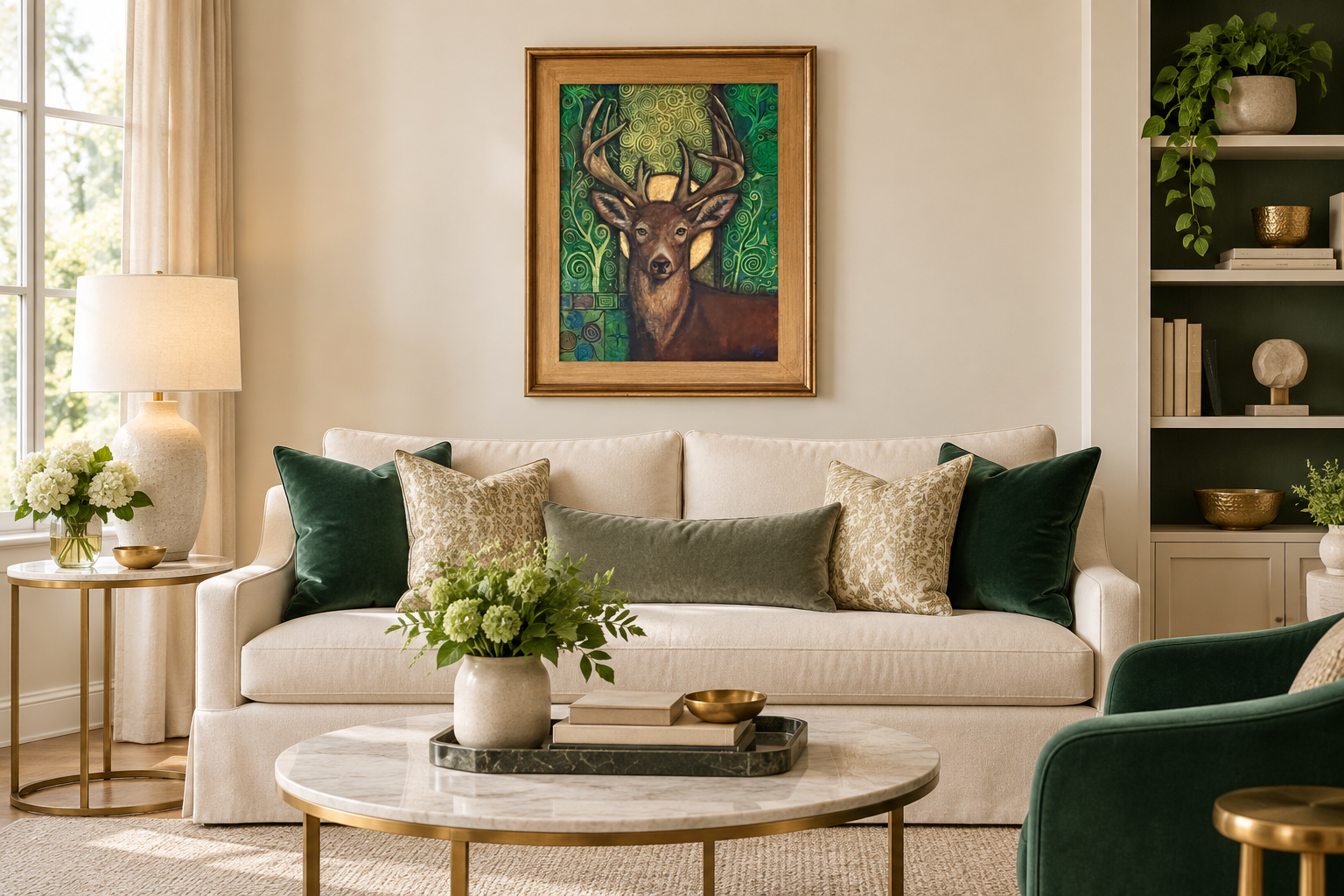
Let One Animal Hold the Room
A wildlife painting often has enough presence to serve as the focal point by itself.
Instead of surrounding it with antlers, animal figurines, plaid fabrics or additional wilderness imagery, give the artwork some breathing room. Place it above a console, near a reading chair or on the main wall of an office.
A single strong piece can say more than an entire themed arrangement.
If the painting contains intricate pattern or texture, keep nearby accessories relatively simple. A ceramic vessel, a stack of books or a small branch may be all the room needs.
The goal is not to repeat the subject. It is to create a setting where the artwork can be noticed.
Pull One or Two Colors Into the Room
Wildlife art does not need to match the room exactly, but a small color connection will help it feel intentional.
Study the painting and choose one or two less-obvious colors to repeat elsewhere. You might draw from:
A soft blue in the shadows
A warm ochre highlight
A quiet violet in the background
A deep charcoal line
A glimmer of gold
Those colors can appear in a pillow, vase, book cover, lamp or throw. They do not need to be identical. Even a gentle relationship between the colors will help the artwork settle naturally into the space.
This approach is especially effective when the animal itself is painted in neutral or earth-based tones. The supporting colors give you more freedom than trying to match the fur, feathers or surrounding landscape.
Use the Frame to Set the Tone
The frame can move wildlife art toward rustic, traditional, contemporary or quietly glamorous.
For a cleaner look, consider:
Narrow black or charcoal frames
Pale natural wood
Warm walnut with simple lines
Soft gold without ornate carving
A white or cream mat around works on paper
Dark distressed wood can be beautiful, but it immediately strengthens the cabin feeling. If that is not what you want, choose a simpler profile.
Mixed-media paintings with metallic elements can look especially lovely in understated gold or dark frames. The frame echoes the artwork without overpowering it.
Pair Wildlife Art With Unexpected Pieces
Wildlife art does not need to be grouped only with landscapes or other animals.
Try pairing it with:
An abstract painting that shares one color
A small botanical watercolor
Black-and-white photography
A vintage mirror
A simple line drawing
A favorite handwritten note or meaningful object
A landscape connected to the animal’s natural environment
The contrast helps the room feel collected rather than themed.
For example, an owl painting beside a delicate botanical creates a thoughtful conversation between wisdom and growth. A powerful stag near an abstract work can soften the division between representation and pure color.
Choose pieces with a shared mood rather than an identical subject.
Pay Attention to the Animal’s Gaze
One small detail can have a surprisingly large effect: the direction the animal is facing.
When possible, position the artwork so the animal looks into the room rather than toward the nearest wall or doorway. This creates a subtle sense of connection and helps guide the viewer’s attention through the space.
A forward-facing animal creates a stronger encounter. It can work beautifully in an entryway or above a fireplace, where the artwork is meant to hold attention.
An animal shown in profile may feel quieter. It can guide the eye toward a window, another artwork or a meaningful object nearby.
These are not rigid rules. They are simply ways to become more aware of how a painting participates in the room.
Give Texture the Right Light
Textured and metallic artwork changes as the light changes.
Hang it where natural or directional light can move gently across the surface, but avoid placing original art in harsh, prolonged sunlight. Side lighting often reveals raised marks and subtle metallic details more effectively than a bright light aimed directly at the center.
In the evening, a picture light or nearby lamp can create a different experience altogether. Texture becomes more visible, while gold accents may appear and disappear as you move through the room.
Artwork with a changing surface rewards a second look. It can feel different at breakfast than it does at the end of the day.
Select the Right Scale
A common decorating mistake is choosing art that is too small for the wall.
Above a sofa, bed or large console, the artwork or grouped arrangement should feel connected to the furniture beneath it. A small piece floating alone on a broad wall may lose its visual strength.
Smaller wildlife paintings work well:
In reading corners
Between windows
Above a narrow cabinet
On a bookshelf
As part of a thoughtful gallery wall
In an office or bedside arrangement
Larger paintings need more space around them. Let them command the wall without asking nearby objects to compete.
Before purchasing, mark the artwork’s dimensions on the wall with painter’s tape. Live with the outline for a day or two. This simple step makes scale much easier to judge.
Build a Collection Slowly
A meaningful home does not need to be completed all at once.
Begin with the animal or image that stays in your thoughts after you leave the room. Over time, you may notice connections between the pieces you are drawn to: similar colors, repeated symbols, a shared quality of light or a feeling of quiet strength.
Those connections become the beginning of a personal collection.
Original artwork brings the artist’s hand into your home through the actual surface, texture and individual marks. Limited-edition and open-edition prints offer another way to live with artwork you love while choosing the size and format that work for your space.
There is room for all of these within a thoughtful collection. The most important consideration is not category or price. It is whether the work continues to speak to you.
Choose the Animal That Feels Like Yours
The right wildlife painting does not require a rustic room. It requires a genuine connection.
Look beyond the decorating category and notice your response. Does the animal make you feel steadier? More hopeful? Protected? Understood?
Art becomes part of daily life. You pass it when the house is quiet, see it in changing light and carry its meaning through different seasons.
Choose the piece that brings something worthwhile into the room.