
My Mixed-Media Painting Process: Why I Begin in Acrylic and Finish in Oil
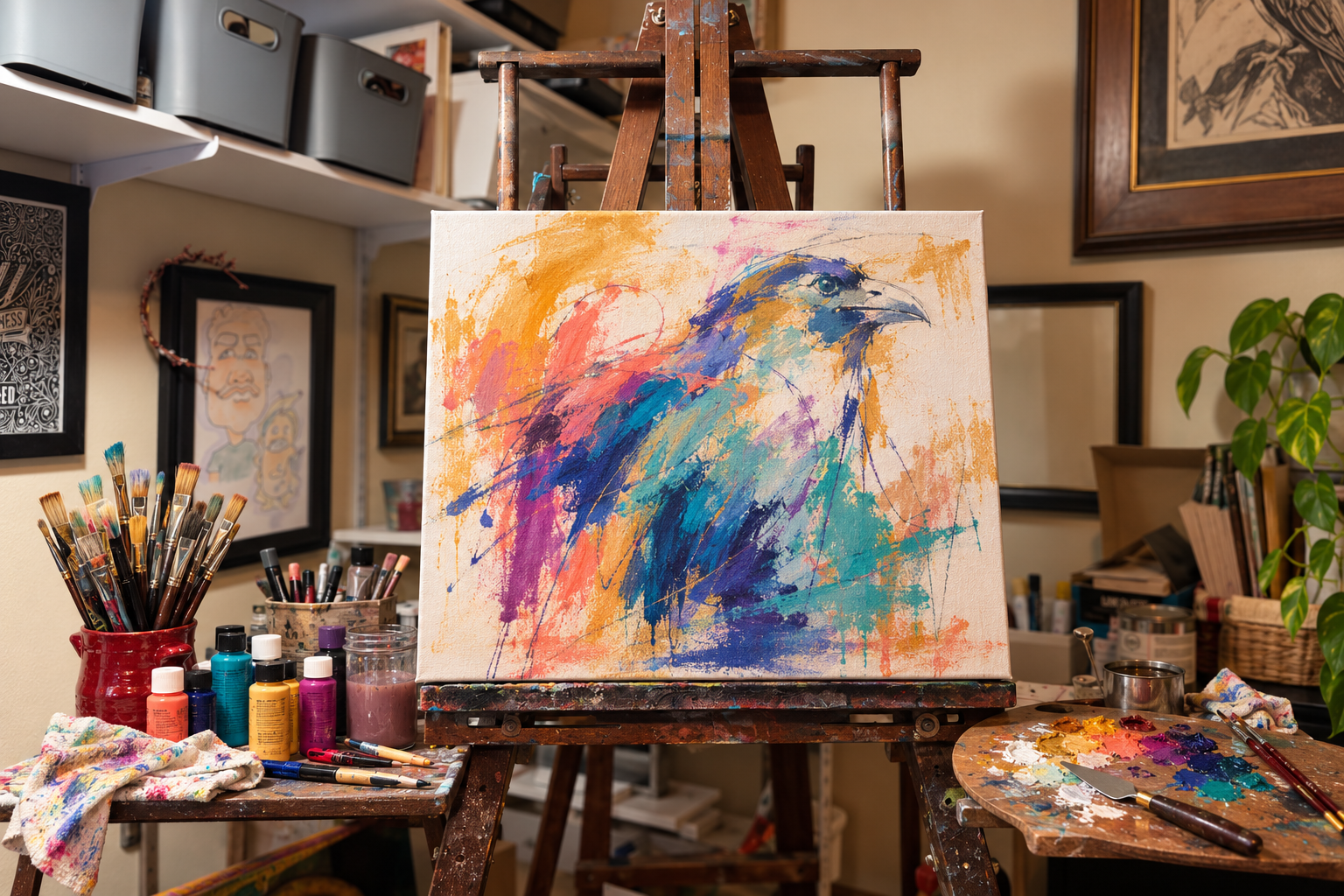
A finished painting can look as though it arrived fully formed. Mine rarely begins that way.
The first stage is usually loose, colorful and slightly unruly. Acrylic paint moves across the surface quickly. Ink creates lines I could not make with a brush. A marker may establish a shape, while a scraped or sprayed area interrupts everything I thought I had planned.
Only later do I bring in oil paint.
Oil allows me to slow down, refine the subject and shape the light. It gives me the depth and softness I want around an animal’s eyes, the turn of a face or the quiet glow along the edge of a mountain.
That contrast is central to my mixed-media painting process. The earlier layers carry energy and discovery. The oil layers bring clarity. I need both.
The Painting Begins With a Feeling
Before I choose individual colors, I think about the emotional direction of the painting.
Do I want it to feel steady? Hopeful? Protective? Joyful? Quietly powerful?
When I paint wildlife, I am interested in more than accurately describing fur, feathers or antlers. I want the animal to have a presence. It should feel as though it belongs to a world beyond the edges of the canvas.
A landscape may begin with a different question. What held my attention in that place? Was it the color of the light, the distance between the mountains or the sudden brightness of a field beneath a dark sky?
These questions do not give me a finished composition. They give me a place to begin.
Why I Start With Acrylic
Acrylic paint lets me work before I have solved every problem.
It dries relatively quickly, so I can establish broad areas of color, cover them, scrape into them and respond without waiting several days between decisions. That speed keeps the early stage from becoming too careful.
At this point, I am not trying to paint every detail of the final subject. I am looking for movement.
A diagonal sweep might suggest wind. A warm patch beneath a cool background may later become sunlight. An accidental line can redirect the entire composition.
Some of these early marks disappear beneath later layers. Others remain visible in small openings, giving the finished painting a history that a single layer cannot provide.
The Underpainting Sets the Emotional Temperature
An underpainting is the first painted foundation beneath the more developed image.
It can establish value, composition and color before the final details are added. I often use this stage to set the emotional temperature of the piece.
A warm underpainting may allow touches of gold, coral or crimson to show through cooler colors placed above it. A dark foundation can make the subject appear to emerge from shadow. Blue or violet beneath a landscape can quietly influence the atmosphere even when very little of that first color remains exposed.
The underpainting does not have to resemble the final painting. Its job is to give the finished surface something to respond to.
Adding Marks That a Brush Cannot Make
Once the first painted areas are established, I may bring in other materials.
Depending on the piece, that can include:
Ink
Acrylic marker
Spray paint
Scraped or lifted paint
Patterned marks
Metallic details
Gold leaf
Palette-knife texture
I do not use every material in every painting. Each one needs a reason to be there.
Ink can provide a confident line. Spray paint creates soft transitions and irregular edges. A marker can repeat a shape or add structure. Metallic elements respond to changing light and may appear stronger from one angle than another.
These materials loosen my thinking. They also help the surface feel discovered rather than decorated.
Allowing the Subject to Emerge
There is a point when the background begins to suggest what the painting needs.
The realistic subject may have been planned from the start, but I still want it to feel connected to the marks surrounding it. If I define it too soon, it can sit on top of the background instead of belonging within it.
I gradually strengthen the drawing and refine the proportions. Some background colors cross into the subject. A line may continue behind a shoulder, wing or branch. Small fragments of the underpainting remain visible around the edges.
This helps unite realism with abstraction.
The animal, figure or landscape becomes recognizable, but the painting still carries evidence of the earlier, more intuitive stage.
Why Oil Comes Last
Oil paint changes my pace.
Acrylic encourages me to move, make decisions and build momentum. Oil gives me time to blend transitions, adjust edges and study subtleties.
This is where I can pay closer attention to:
The expression around an animal’s eyes
The direction and softness of fur
Reflected color within a shadow
The warmth of light along an edge
The distance between foreground and background
Small color changes that make a form feel dimensional
The order of the materials matters. My water-based acrylic and mixed-media layers come first and are allowed to dry. Oil paint is then used on top. I do not place acrylic over an oil layer.
Oil gives the final subject a visual weight that holds its own against the active background. It allows realism and imagination to meet without either one overwhelming the other.
Keeping Some Edges Quiet
Not every part of the subject needs the same level of detail.
I may carefully develop an eye, muzzle, flower or illuminated ridge while allowing another area to dissolve into broad brushwork. A sharply painted edge attracts attention. A softened edge gives the eye permission to move elsewhere.
This balance is important to me.
If every inch receives equal detail, the painting can become visually noisy. If everything remains loose, the subject may lack the presence I want it to carry.
The most refined area becomes an invitation. The surrounding marks provide atmosphere, movement and space.
Letting Earlier Layers Remain Visible
It can be tempting to cover every uncertain mark as a painting becomes more realistic. I try not to erase all of them.
A flash of unexpected color beneath an animal’s fur or a scratched line beside a carefully painted eye creates tension. It reminds us that we are looking at paint, not a photograph.
Those remaining marks are often where the life of the painting resides.
They reveal that the image changed. Decisions were made, abandoned and reconsidered. The final surface contains more than the last thing I painted.
It holds the memory of the process.
How This Process Shapes Guardians of the Quiet Earth
In my Guardians of the Quiet Earth collection, each animal is meant to feel both earthly and symbolic.
The realism gives us a point of connection. We recognize the owl, wolf or stag. We understand something of its physical presence.
The surrounding pattern, color and texture open another possibility. The animal can become a guardian, messenger or quiet companion without losing its wildness.
That is why mixed media feels so natural for this collection. Realism alone would not tell the whole story. Abstraction alone would not create the same meeting of eyes.
The layers allow both truths to exist together.
What You Notice When Viewing an Original
Photographs can show the composition and color of a painting, but they cannot fully reproduce the surface.
In person, you may notice a raised palette-knife mark, a thin line beneath a translucent passage or a metallic detail that changes as you walk past it. One area may absorb light while another reflects it.
These small shifts create a physical experience. The painting does not look exactly the same in morning light as it does beneath an evening lamp.
That changing relationship with light is part of what I love about creating layered work.
Knowing When to Stop
Finishing a painting is not simply a matter of adding more detail.
Near the end, I begin asking different questions:
Does the eye know where to rest?
Is the subject present without feeling overworked?
Do the abstract areas support the story?
Is there enough quiet space?
Does the light feel believable?
Is the original feeling still alive?
Sometimes the final decision is an added highlight. More often, it is the decision to leave an area alone.
A painting needs enough information to speak clearly, but it also needs room for the viewer to enter.
Living With a Painting That Holds Its History
My paintings begin with movement and uncertainty, then gradually become more focused. That pattern feels true to life.
We do not become ourselves through one perfect decision. We are shaped through layers: memory, change, discovery, loss, courage and light.
I want the finished painting to feel refined, but never empty of that history. The early marks may be partly hidden, yet they continue to influence everything placed above them.
That is why I begin with freedom and finish with intention.
Explore the original mixed-media paintings and nature-inspired artwork at JaeBird Studio, including the animals of Guardians of the Quiet Earth.